
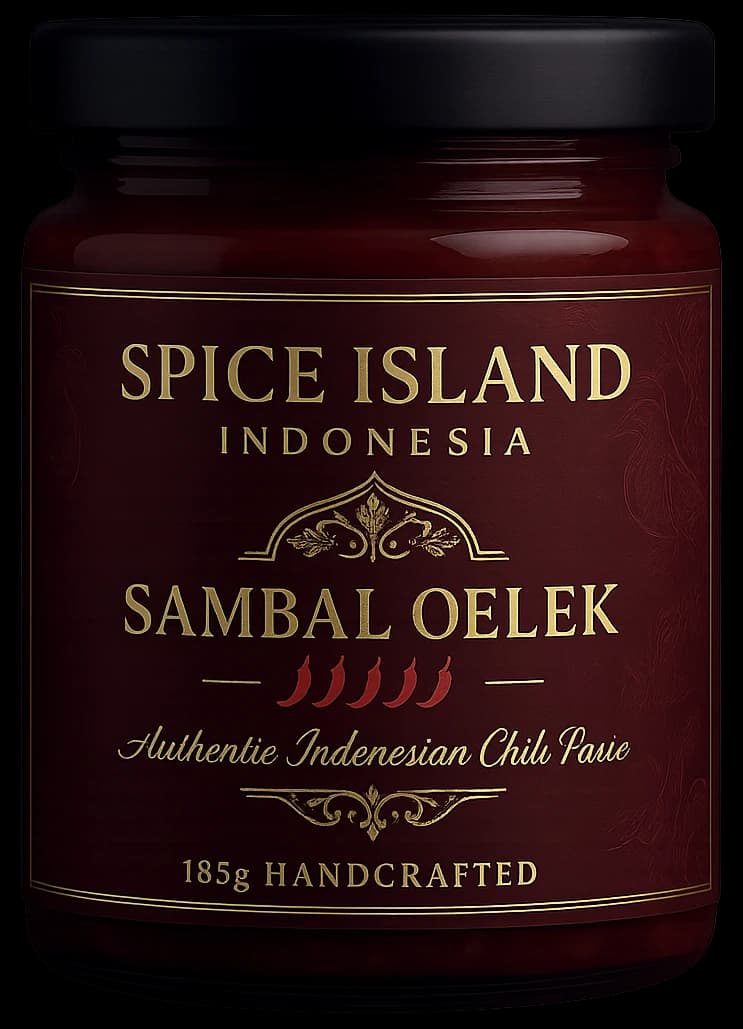
What's Really in Store-Bought "Sambal"?
The shocking truth about what passes for "Indonesian sambal" in UK supermarkets.
Mass Production
Made in industrial facilities using shortcuts and artificial flavours to mimic authentic taste.
Chemical Preservatives
Loaded with sodium benzoate, potassium sorbate, and other chemicals for shelf stability.
Fake Indonesian
Often made in Europe or Asia with "Indonesian-style" recipes that bear no resemblance to authentic sambal.
Authentic vs Store-Bought: The Complete Breakdown
Authentic Indonesian Sambal
Chef Yossie's Traditional Method
Fresh Ingredients Daily
Hand-selected chilies, garlic, and shallots
Traditional Stone Grinding
Preserves essential oils and natural textures
Family Recipes
Passed down through generations in Bandung
No Preservatives
Natural fermentation and traditional preservation
Small Batch Production
Quality control and attention to detail
Complex Flavor Profile
Layers of heat, sweetness, and aromatics
Store-Bought "Sambal"
Mass-Produced Imitation
Processed Ingredients
Dried chilies, garlic powder, artificial flavours
Industrial Blending
High-speed processing destroys natural compounds
Generic Formulas
Designed for mass appeal, not authenticity
Chemical Preservatives
Sodium benzoate, potassium sorbate, citric acid
Mass Production
Thousands of jars per hour, no quality control
One-Dimensional Taste
Just heat and salt, no complexity or depth

"I Can Taste the Difference Immediately"
Chef Yossie's 20+ years in professional catering taught her to recognize authentic Indonesian flavours instantly. She's shocked by what UK stores call "sambal."
"When I first tried store-bought 'sambal' in the UK, I was heartbroken. It tasted nothing like the sambal my grandmother taught me to make. That's why I started making authentic sambal here - to preserve the real flavours of Indonesia for people who deserve better than mass-produced imitations."
— Chef Yossie, Bandung-born Indonesian Chef
What Makes Sambal Taste Authentic
Look past the label and compare ingredients, texture and cooking method.
Check the ingredients
Chilli, aromatics and seasoning should be easy to identify.
Notice the texture
Traditional sambal is pounded or ground, not blended into a uniform sauce.
Taste it in a dish
Good sambal brings heat, aroma and savoury depth without overwhelming the food.